Develop expertise in wealth management, investment portfolios and financial advisory through the Executive MBA - Wealth Management at IIM Mumbai.
Access programme digital resources
The programme combines 20 core courses, four electives and two capstone projects across four modules, with 77 credits and 770 learning hours.
Programme Objectives
Program Objective
- To equip professionals with in-depth knowledge of wealth management, investment strategies, risk assessment, and estate planning to navigate the evolving financial landscape.
- To strengthen participants' ability to analyse financial markets, optimise investment portfolios, and make data-driven decisions for wealth creation and preservation.
- To provide cutting-edge insights into financial planning, taxation, and behavioural finance, ensuring career advancement in the wealth management industry.
- To instil ethical wealth management practices and customer-focused financial advisory skills to build trust and long-term client relationships.
- To enable participants to apply financial theories to real-world scenarios through case studies, expert sessions, and industry interactions.
- To develop leadership capabilities to manage high-net-worth portfolios, advise clients effectively, and drive financial growth in a dynamic market.
Programme Structure
Program Structure
| Sr. No. | Type of Courses | No. of Courses | Total Credits |
|---|---|---|---|
| 1 | Core Course | 20 | 45 |
| 2 | Electives | 4 | 12 |
| 3 | Capstone Project | 2 | 20 |
| Total | 770 hours | 77 |
Module-wise breakdown of programme structure
| MODULE | Number of courses | Type of course | Credit Per Course | Total Credits |
|---|---|---|---|---|
| Module 1 | 7 | Core/Elective | 1.5/3 | 15 |
| Module 2 | 7 | Core/Elective | 1.5/3 | 15 |
| Capstone Project | 2 | 10 | 20 | |
| Module 3 | 7 | Core/Elective | 1.5/3 | 15 |
| Module 4 | 7 | Core/Elective | 1.5/3 | 12 |
| Total Credits | 77 | |||
Course Curriculum
| S. N | Course Title | Course Type | No of Hours | No of Credits |
|---|---|---|---|---|
| Module I | ||||
| 1 | Business Statistics, Linear Optimization | Core | 30 | 3 |
| 2 | Behavioral Finance for Wealth Management | Core | 30 | 3 |
| 3 | Wealth Products | Core | 15 | 1.5 |
| 4 | Leverage and Margin Financing | Core | 15 | 1.5 |
| 5 | Client Prospecting, Negotiation and Influencing | Core | 15 | 1.5 |
| 6 | Elective 1 | Elective | 30 | 3 |
| 7 | Etiquette Workshop | Workshop | 15 | 1.5 |
| Total | 150 | 15 | ||
| Module II | ||||
| 1 | Introduction to Financial Markets (Banks/NBFCs/Equity/Debt) | Core | 30 | 3 |
| 2 | Asset Allocation Methodologies | Core | 15 | 1.5 |
| 3 | Macro Economics | Core | 15 | 1.5 |
| 4 | Estate Planning | Core | 30 | 3 |
| 5 | Legal and Ethical Considerations in Wealth Advisory | Core | 15 | 1.5 |
| 6 | Elective 2 | Elective | 30 | 3 |
| 7 | Workshop on Credit Structuring (Cashflows, Collateral, Opco/Holdco, IRR) | Workshop | 15 | 1.5 |
| Capstone Project 1 | 100 | 10 | ||
| Total | 250 | 25 | ||
| Module III | ||||
| 1 | Basics of Taxation & Fundamentals of AI/ML | Core | 15 | 1.5 |
| 2 | Business Accounting | Core | 15 | 1.5 |
| 3 | Derivative Strategies | Core | 30 | 3 |
| 4 | Investment Tax Planning | Core | 15 | 1.5 |
| 5 | Digital Client Engagement | Core | 30 | 3 |
| 6 | Marketing Electives | Elective | 30 | 3 |
| 7 | Workshop on Tax Computation (Company, Investments, Personal) | Workshop | 15 | 1.5 |
| Total | 150 | 15 | ||
| Module IV | ||||
| 1 | Mutual Funds, Distribution Guidelines | Core | 15 | 1.5 |
| 2 | Corporate Finance | Core | 15 | 1.5 |
| 3 | Fundamentals of Insurance | Core | 15 | 1.5 |
| 4 | Financial Planning | Core | 15 | 1.5 |
| 5 | Digital Transformation in Wealth Management, Future trends (AI/ML) | Core | 15 | 1.5 |
| 6 | Finance Electives | Elective | 30 | 3 |
| 7 | Family Office Workshop (Portfolio Analysis and Recommendations) | Workshop | 15 | 1.5 |
| Capstone Project 2 | 100 | 10 | ||
| Total | 220 | 22 | ||
Eligibility
Eligibility Criteria
- 1st Class Graduates with relevant post qualification experience of at least two years
- Engineers with relevant post qualification experience of at least 2 years
- 1st class is 60% and above. In case of Grades, the UGC grade convertor will be applied to determine percentage equivalence. (SC/ST candidates will be eligible for relaxation as per rules)
- Candidates having experience in banking and wealth management are encouraged to apply
Important Dates
| Particulars | Date |
|---|---|
| Advertisement Opens | 01st August 2025 |
| IMAT Exam | 08th March 2026 |
| Program Commencement | April 2026 |
Admission Process
Application Selection & Procedure
Application Process
Initially, the program will have a total of 50 seats. Interested and eligible candidates should apply to MBA - Wealth Management and register on Application Portal “The IIM Mumbai website” during the window of time provided in the advertisement for admissions.
Online Application Fees
When applying online for the MBA - Wealth Management, candidates must first register and pay a one-time registration fee of INR 2500. Please note that this application fee is non- refundable and non-adjustable under any circumstances.
Programme Fees
Program Fees
The gross fee applicable per student for the MBA - Wealth Management is ₹ 15.00 Lakhs plus applicable government taxes, if any for Semi-annual installments. The student may opt for the full Payment or installment payment. A refundable caution money deposit of INR 50,000/- will be collected in addition to the gross fee, which will be refunded to the student on graduating from the Institute or adjusted against the outstanding dues in respect of the student. Following is the detailed schedule for the proposed fee payment.
To secure your admission, a non-refundable provisional offer confirmation fee of INR. 1 Lakh is required. This fee will be deducted from your final tuition fees.
| Sr No | Installment No | Installment Amount (INR)* | Due Date |
|---|---|---|---|
| Candidate Opting for the Annual Fee Payment Structure (Total: 15 Lakhs) | |||
| One Lakh Rupees to be deposited to book a seat for admission before the deadline | |||
| 1 | First Installment | 7.00 Lakhs | Before the commencement of the Program – January 15, 2026 |
| 2 | Second Installment | 7.00 Lakhs | After the Module-II – July 15, 2026 |
* applicable government taxes, if any will be extra.
# Mess charges are not included.
Offer Acceptance, Withdrawal and Refund
Candidates shortlisted for provisional admission to the MBA - Wealth Management at IIM Mumbai will be informed by email and/ or online notification. Individual regret communication will not be sent to the applicants. A candidate receiving an admission offer from IIM Mumbai and accepting the offer within the stipulated date as specified must pay the full / Partial admission fee, as applicable to secure the seat in a Program. That is, all the candidates accepting a seat must pay the initial fees of Rupees 1.0 Lakhs to book his/her seat, and then, depending on the fee option chosen (annual or module-wise), must pay the balance fees as per the timelines. Further, if a candidate subsequently withdraws the admission at any point, the amount will be refunded as per the guidelines. The candidate must make a written application/e-mail request for the withdrawal of admission.
| Sr No | Particulars | Admission Withdrawal time | Refund Amount |
|---|---|---|---|
| 1 | Candidate withdrawing admission after the full payment – Rs. 15 Lakhs | After the commencement of the classes | Rs 50,000 |
| 2 | Candidate withdrawing admission after the Partial payment – Rs. 7.00 Lakhs | After the commencement of the classes | Rs 25,000 |
| 3 | Candidate withdrawing admission after the seat booking amount – Rs 1.00 Lakhs | After the last date of admission | Nil |
The program's admission shall be closed once the number of sanctioned seats gets filled or candidates are unavailable as per the decided cut-off in the final merit list or the Last Date of making Payment.
Learning and Evaluation
Student Learning and Evaluation Process
Teaching Pedagogy
Pedagogical methods may vary from course to course, but IIM Mumbai incorporates contemporary best practices commonly used in leading business schools. These include concept teaching and discussions, case studies, role plays, group activities, individual and group presentations, self-directed projects, student-led sessions, simulation exercises, and business games. These diverse teaching methods aim to immerse students in real-world situations, equipping them to tackle challenges and develop effective problem-solving skills. Additionally, these approaches are designed to foster interactive and engaging classroom environments, enhancing student participation and enriching the overall learning experience.
Industry Expert Lectures
The institute organizes lectures by eminent industry experts, providing valuable insights from leaders in various fields. These online expert lectures offer a multi-faceted perspective through the speakers' experiences in areas such as national and international business, current technology trends, business challenges, and strategies for overcoming them. Throughout the year, the institute hosts numerous distinguished speakers in both offline and online formats, enriching the learning experience for students.
Simulations /Business Games
Business simulations and games are software programs designed to replicate real-life business scenarios. These interactive environments enable students to immerse themselves in realistic business settings, applying various policies and strategies learned from their courses to enhance their decision-making skills in context-specific situations.
Student Evaluation
Continuous assessments and exams are a part of the program structure to evaluate participants’ understanding and application of the concepts covered. The specific assessment methods may vary and will include assignments, case studies, presentations, and examinations.
Subject Course Evaluation Process
The MBA - Wealth Management comprises 20 core courses and 4 elective courses from a basket 24 subject from six areas. Students will be evaluated individually for these courses based on various criteria, including participation in classes and case discussions, class preparation, and understanding and application of concepts. The evaluation process will consist of a combination of assignments, case studies, presentations, and examinations. The distribution of marks for examinations, along with the weight and duration for three-credit courses, is detailed below:
| Evaluation | Total Marks | Pass Marks (40%) | Exam duration |
|---|---|---|---|
| Continuous evaluation (assignment/quiz/case study/class engagement etc) | 40 | 16 | Continuous evaluation during the Module |
| Mid-Term Exam | 20 | 8 | 1 hour |
| Module ending examination (Final Exam) | 40 | 16 | 2 hours |
In Continuous Evaluation, students shall be evaluated based on Individual Assignments/class participation /Presentations/ Projects/ Research article analysis/ Case- based discussion, etc. The subject faculty shall choose the evaluation process and its weightage for each component. The Mid-Term Exam will be based on the syllabus covered, and it will be conducted by the concerned faculty around mid of the term (for 3 credit courses after 10 classes of 1.5 hours each). The end-module examination will normally cover the entire syllabus of the course, while the mid-module assessment will be based on the portion covered till then. Module-ending examination evaluation will include subjective questions, case studies and multiple-choice questions to test the understanding of the subject matter. The module-ending exam shall be conducted at the end of the module.
No student shall absent themselves from an examination, class test, or project presentation except in case of matters of dire exigency. If the student is absent during the examination, a nominal fee of ₹ 5000/- per subject will be charged for the students who have not attended their examinations for conducting the re-examination process. If the student appears in the re- examination in the End-Module or Mid-Term examination, he/she will get one grade less in that course, even if the total marks obtained in the course are higher than 40%.
If a student does not appear in the re-examination, he/she will be automatically assigned the Grade ‘F’ for the course and declared failed. If a student fails in any course due to securing low marks in the End-Module or mid-term examination (either regular or re-examination), the student shall be permitted to appear in the re-examination only twice (a nominal fee of ₹ 5000/- per subject), after which the student shall repeat the subject whenever it is offered subsequently. He/she has to pay the course re-registration and administration fees of Rupees 25,000/- per subject.
Capstone Project
The Capstone Project for the MBA - Wealth Management is a vital component designed to provide students with practical, hands-on experience in real-world business environments. This project allows students to apply the concepts and theories learned in the classroom to actual business challenges, thereby bridging the gap between academic knowledge and professional practice. During the project, students will work with leading organizations, gaining insights into industry operations, enhancing their professional networks, and developing critical skills in areas such as strategic decision-making, problem-solving, and leadership. The project not only enriches the learning experience but also significantly boosts career prospects by equipping students with the practical expertise and confidence needed to excel in their professional endeavors.
Student Grading and Result
For each course, including the Capstone Project, students receive a letter grade based on their overall performance across all assessments. In the event of a grading dispute, the Director or an appointed authority will re-evaluate the answers and grades, and their decision will be final and binding.
The grading components are divided as follows:
- Continuous evaluation: 40%
- Mid-term evaluation: 20%
- Final evaluation: 40%
The concerned faculty member will announce the dates for class tests, assignment submissions, and other continuous evaluation components.
All examination passing and grading criteria, including the result moderation process, will adhere to the current PGP rules of the institute. Additionally, grades will be linked to class attendance as per the institute’s rules. The calculation of the Grade Point Average (GPA), Cumulative Grade Point Average (CGPA), and the Equivalence Formula for Percentage Conversion from CGPA will follow the institute's existing regulations.
Successful Programme Completion
Successful Program Completion
Students who complete the program will be awarded a MBA - Wealth Management. Based on their CGPA scores, students will be classified into divisions according to institute rules and procedures.
In the case of grievances or disputes regarding academic matters, the existing institutional academic rules will apply. IIM Mumbai will provide an Ombudsman to resolve grievances. The Director of IIM Mumbai serves as the Chairperson of the Academic Council and the appellate authority for all academic and administrative matters. The decision of the Director is final and binding. Any legal disputes will fall under the jurisdiction of the Mumbai High Court.
Contact Us
 Address:
Academic Office
INDIAN INSTITUTE OF MANAGEMENT MUMBAI
Vihar Lake Road, Post Office IIM Mumbai,
Powai, Mumbai,
Maharashtra, 400087


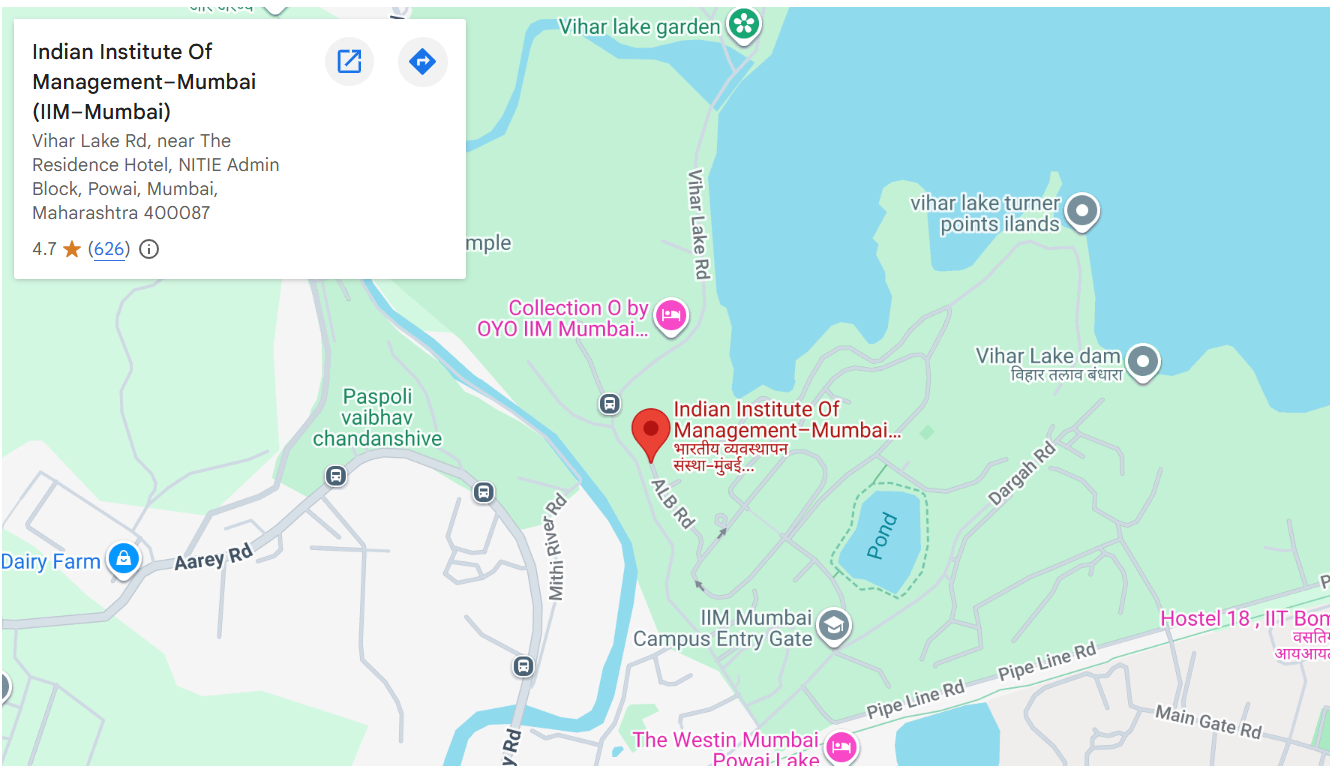
Location